
Botanix: Deconstructing the Spiderchain architecture
A technical deep-dive into Bitcoin's newest Layer 2 primitive and its approach to distributed custody

TL;DR: Botanix introduces Spiderchain, a novel Bitcoin L2 primitive that distributes multisig custody across a network of rotating wallets. Using customized FROST cryptography and forward security mechanisms, it attempts to solve the trust assumptions inherent in most Bitcoin L2s. The mainnet launched in July 2025 with 16 federated operators, offering 5-second finality and EVM compatibility while maintaining Bitcoin-native custody.
The Bitcoin Layer 2 landscape has been dominated by compromise. Either you trust a federation, accept centralized bridges, or wait for theoretical zk-rollup implementations that remain perpetually "under research." Botanix Labs claims to have introduced a new primitive that sidesteps these trade-offs entirely.
After examining their architecture and mainnet implementation, here's what Spiderchain actually is, and whether it delivers on its promises.
The Bitcoin L2 landscape: A study in trade-offs
Most production Bitcoin L2s today follow a predictable pattern. You send BTC to a multisig controlled by the L2 operators, receive a wrapped version on their chain, and trust they'll honor withdrawals. Lightning Network remains the exception, a true L2 primitive for payments, but everything else essentially boils down to federated custody with extra steps.
Bitcoin's limited scripting capabilities force this reality. The base layer cannot verify complex smart contract logic, so L2s must choose between security models: centralized multisigs (fast but trusted), zk-rollups (theoretical but trustless), or federated approaches (middle ground with known validators).
Botanix's thesis is that this binary choice is false. Their approach: distribute the custody itself rather than simply federating it.
Spiderchain: Distributed Custody as a Primitive
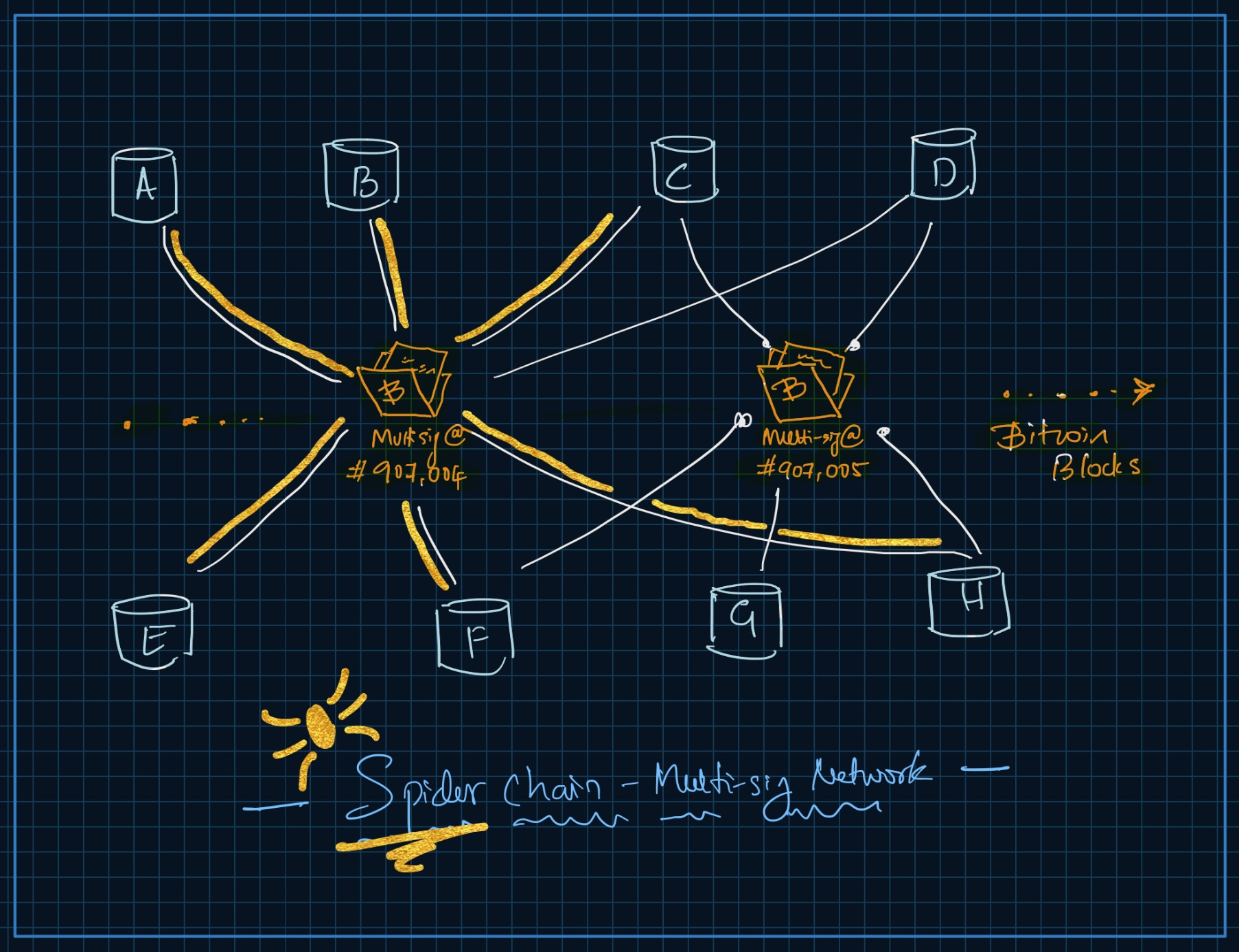
At its core, Spiderchain is a network of multisig wallets where no single entity controls the keys. But the implementation details reveal the actual innovation.
Traditional Multisig limitations vs. Spiderchain's approach
Standard multisig setups require all parties to be online simultaneously, expose signers on-chain, incur higher fees with larger signer sets, and create operational complexity. More fundamentally, they still represent a single point of custodial control.
Spiderchain restructures this entirely:
Network-Level Signing: The signer network manages multisig UTXOs as single signatures at the protocol level, eliminating coordination requirements between individual signers.
Multiple Rotating Multisigs: Rather than one large multisig, the system creates a web of smaller multisigs that rotate based on Bitcoin block production.
Randomized Participation: Verifiable Random Functions (VRF) determine which Orchestrator nodes participate in each multisig, preventing predictable attack vectors.
LIFO Processing: Withdrawals process against the most recent deposit UTXOs, optimizing for liquidity and operational efficiency.
The result resembles a spider's web, multisigs form the connection points, with Orchestrator nodes accessing them through randomized, cryptographically secured pathways.
FROST protocol: Custom cryptography for distributed keys
Spiderchain's security foundation relies on FROST (Flexible Round-Optimized Schnorr Threshold Signatures), but with critical modifications that address Bitcoin's specific constraints.
Standard FROST implementations use a "Trusted Dealer" setup where a single entity generates a private key, splits it into shares, and distributes them to participants. This creates an obvious attack vector—the dealer could retain the master key.
Botanix implemented distributed key generation (DKG) where no complete private key ever exists. Instead, key shares are generated directly by participating Orchestrator nodes through a cryptographic ceremony. The system maintains DKG state to handle network latency and packet loss, ensuring robust operation under real-world conditions.
FROST's advantage for Bitcoin becomes clear when considering on-chain costs. Large multisigs on Bitcoin incur prohibitive fees, but FROST aggregates public keys and signatures, reducing the on-chain footprint regardless of the actual signer set size.
Forward Security: Limiting compromise impact
The architecture implements two key mechanisms to contain potential security breaches:
Key Rotation: Cryptographic keys and shares refresh periodically, ensuring that compromised keys have limited temporal utility.
Ephemeral Keys: Individual transactions use short-lived keys generated specifically for that communication session, minimizing exposure windows.
This forward security model means that even successful attacks have bounded impact, both in scope and duration.
Orchestrator Nodes: Multi-function network participants
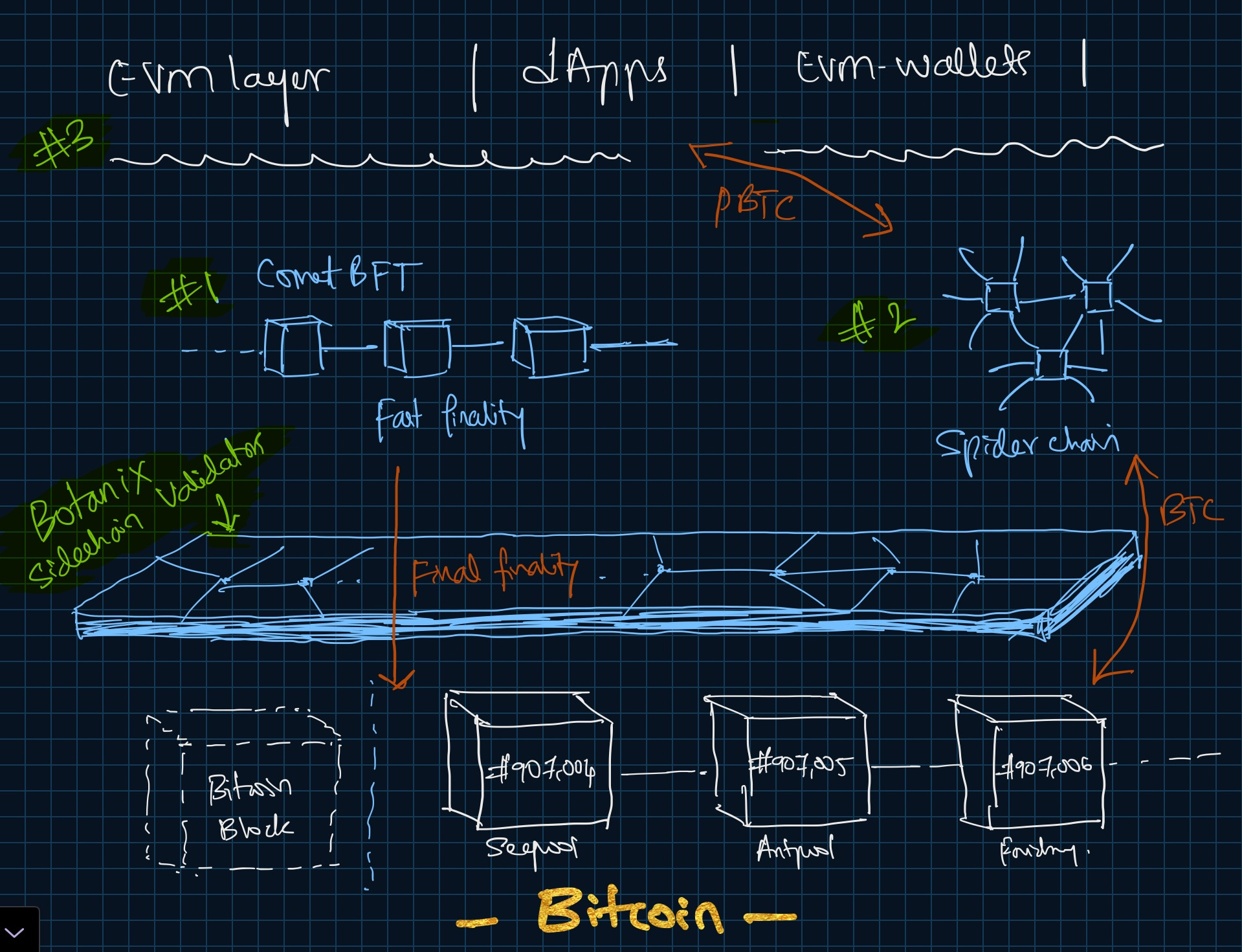
Where Spiderchain becomes particularly elegant is how it extends the Orchestrator node concept beyond simple multisig participation. Each node performs multiple critical network functions:
Consensus: CometBFT for block production
The network employs CometBFT, a Byzantine Fault Tolerant consensus mechanism that provides immediate finality and predictable block times. This drops transaction confirmation from Bitcoin's ~10 minutes to 5 seconds.
CometBFT's advantage lies in its strong security guarantees against malicious validators. Even with up to one-third of validators compromised or offline, the network maintains both safety and liveness properties.
Bitcoin node integration and Dual Finality
Each Orchestrator node runs a full Bitcoin node (bitcoind), maintaining direct connection to the Bitcoin network. This serves two purposes: providing Bitcoin network data for protocol operations and enabling transaction broadcasting.
The dual finality mechanism works by having CometBFT provide immediate L2 finality while periodically inscribing Merkle roots of the L2 state onto Bitcoin itself. Orchestrator nodes verify that only correct Merkle roots are inscribed, creating a cryptographic anchor to Bitcoin's security model.
This approach inherits Bitcoin's re-org resistance while maintaining fast confirmation times, essentially getting the best of both consensus models.
EVM Engine: Leveraging existing ecosystem
For smart contract execution, Botanix forked Reth, Paradigm's Rust-based Ethereum client. This wasn't an arbitrary choice—it allows direct compatibility with Ethereum's mature developer tooling and battle-tested smart contract ecosystem.
The EVM integration means that existing Ethereum applications can deploy to Botanix with minimal modifications, immediately inheriting a decade of DeFi innovation while operating on Bitcoin-native assets.
Mainnet reality check: Current implementation vs. Architecture goals
Botanix mainnet launched in July 2025 with a 16-node federation including Galaxy Digital, Fireblocks, Alchemy, and Antpool. However, the current implementation differs from the full Spiderchain vision in several key areas:
Current State: The network operates with federated consensus among known validators. Multisig creation is based on user EVM addresses rather than Bitcoin block timing, optimizing for operational efficiency during the bootstrap phase.
Roadmap Items: The transition to permissionless BTC staking, full implementation of block-based multisig rotation, and expansion to 100+ node operators represent the path toward the complete Spiderchain architecture.
Performance Metrics: 5-second block times with approximately $0.02 average transaction fees, indicating the system performs as designed from a user experience perspective.
Application Layer: Major DeFi protocols including GMX (derivatives), Dolomite (lending), and Palladium (BTC-backed stablecoin) are operational, demonstrating that the EVM compatibility works in practice.
Technical assessment and implications
Spiderchain represents a genuinely novel approach to Bitcoin scaling that addresses real limitations in existing L2 designs. The cryptographic innovations, particularly the customized FROST implementation with distributed key generation, solve actual problems rather than creating complexity for its own sake.
The architecture's strength lies in its composability. By making Orchestrator nodes multi-functional (consensus, Bitcoin integration, EVM execution, multisig participation), the design achieves operational efficiency while maintaining security properties. This is systems engineering rather than just cryptographic innovation.
However, the current implementation remains federated, requiring trust in known operators. While the roadmap toward permissionless operation is clear, execution risk remains significant. The transition from 16 federated nodes to 100+ permissionless validators will test whether the cryptographic theory translates to operational reality.
The technical execution demonstrates sophistication in both cryptographic design and practical engineering. Whether this translates to adoption depends less on the technology itself and more on market demand for Bitcoin-native DeFi infrastructure.
From a technical perspective, Botanix has delivered a working implementation of genuinely innovative Layer 2 architecture. The remaining question isn't whether the technology works—it's whether the market needs what they've built.
Disclaimers
Botanix is currently in beta mainnet. This means you should only experiment with small amounts of BTC that you can afford to lose. Do not test with significant funds until the network reaches full production maturity.
Disclosure: I have no personal investment in Botanix, nor is this content sponsored by them. This analysis stems from my interest in exploring new BTCFi primitives while building at my own startup, Surge.build. All opinions and technical assessments are my own.
I have personally tested Botanix beta mainnet using funds I specifically reserve for experimentation. This technical analysis is informed by real hands-on experience with the protocol.
This article was written with editorial assistance from Claude AI. All ideas, research, and conclusions are my own