
Is BitVM going to enable Bitcoin DeFi?
Why BitVM's promise falls short of enabling mainstream Bitcoin DeFi

Bitcoin Virtual Machine (BitVM) promises to bring Turing-complete computation to Bitcoin without requiring a soft fork. Created by Robin Linus, BitVM has captured the attention of developers and Web3 enthusiasts as a potential pathway to programmability and DeFi on Bitcoin.
After spending considerable time studying BitVM's technical implementation and nuances, I'm prompted to ask a critical question: Will BitVM actually enable Bitcoin DeFi?
Note: This analysis focuses on the core BitVM library, specifically examining bridge functionality as outlined in the BitVM 2 whitepaper. While teams like Citrea are developing alternative implementations that address some limitations discussed here, I'll cover those separately.
The Bitcoin L2 Context
BitVM's emergence coincides with the explosive growth of Bitcoin Layer 2 solutions following the Ordinals surge and the SegWit/Taproot upgrades. At one point, hundreds of Bitcoin L2 projects sprouted, each attracting significant investment and development interest.
However, this boom quickly revealed fundamental flaws. Most L2s relied on multi-signature or federated bridge models that lacked verifiability and transparency. The resulting "TVL-mirroring" phenomenon and proliferation of vaporware projects eventually dampened enthusiasm. This backdrop made the need for trustless, verifiable bridging solutions increasingly apparent—creating the perfect context for BitVM's optimistic approach.
The Optimistic Approach
BitVM borrows core design principles from Ethereum's optimistic rollups, which successfully scaled Ethereum through off-chain computation with on-chain verification. However, Bitcoin lacks Ethereum's computational flexibility.
BitVM's workaround involves off-chain computation with on-chain verification, enabling trust-minimized (not trustless) BTC bridging. Following optimistic design principles, execution is assumed correct unless proven otherwise—but the implementation differences create vastly different user experiences.
Bridge Experience Comparison
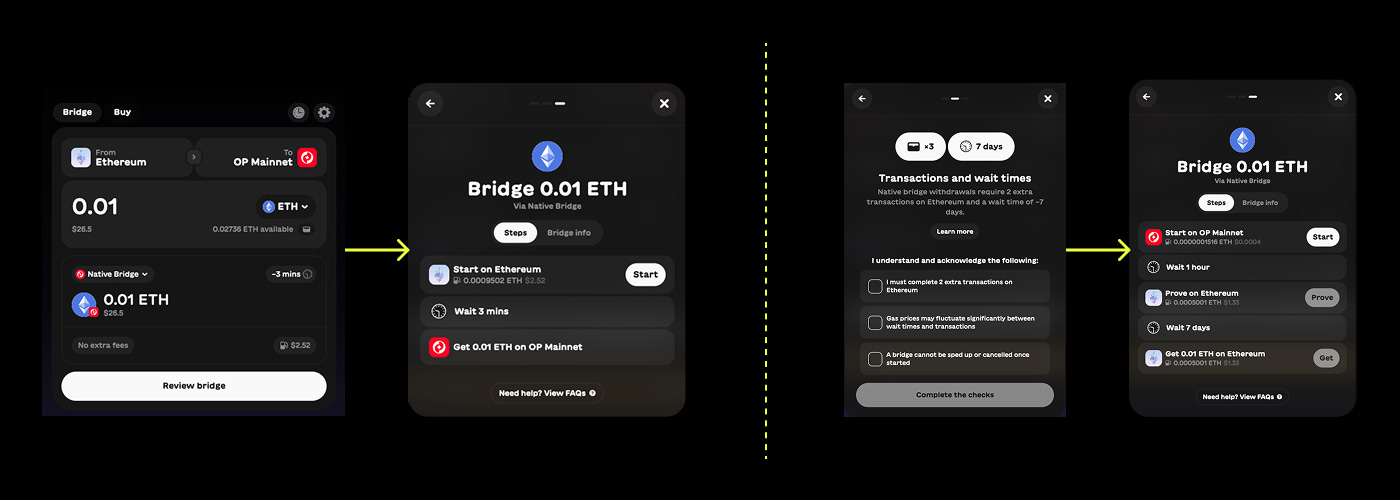
Ethereum ↔ Optimism Bridge Experience
The Ethereum-Optimism bridge offers a seamless, predictable experience:
Peg-in Process:
Users can bridge any amount of ETH
ETH is sent to Optimism's Ethereum contract
Equal amount minted on Optimism within ~3 minutes
Transparent transaction tracking throughout
Peg-out Process:
User initiates transaction on Optimism
7-day challenge period for fraud proofs
Predictable timeline with transparent tracking
Equal amount received on Ethereum
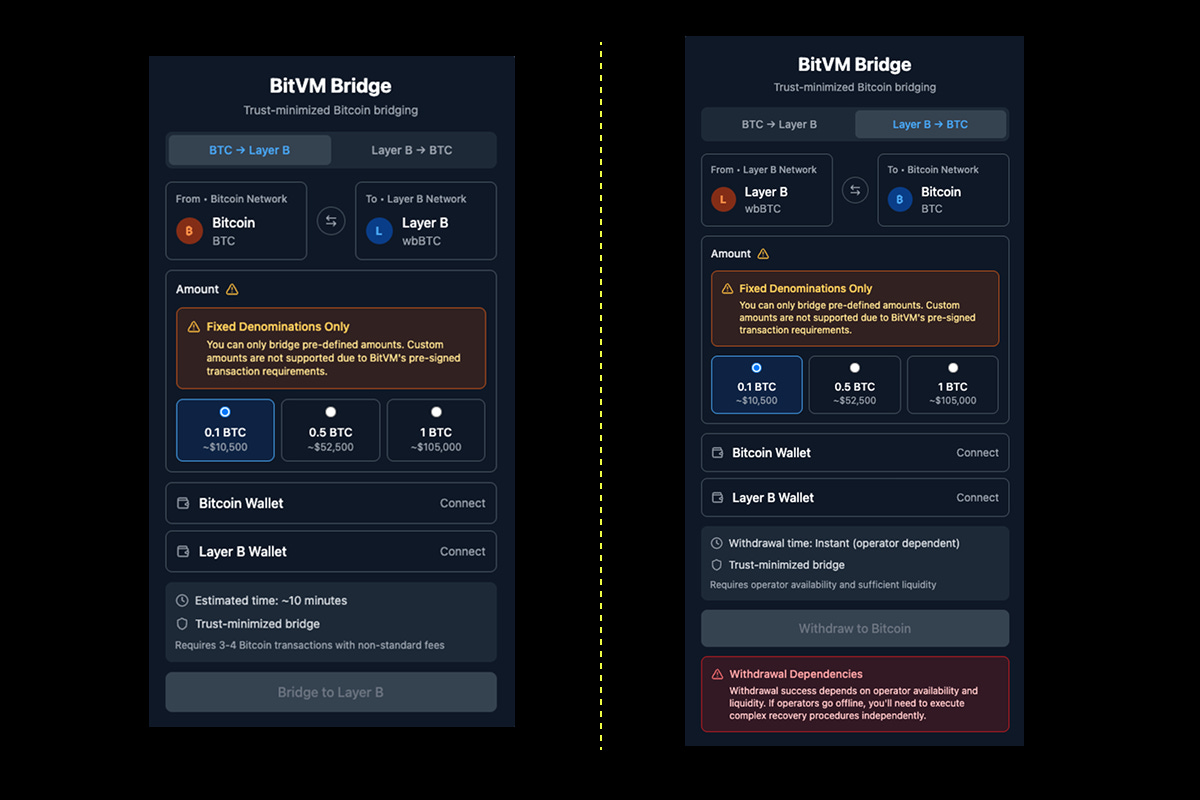
BitVM Bridge Experience
I've discussed the BitVM bridge experience extensively in previous posts, so I won't repeat the detailed analysis here. Instead, refer to the interactive mock interface below that demonstrates the key limitations and user experience challenges inherent to BitVM's design.
Key Differences:
Let me summarize how these differ from user stand point and mass adoption point
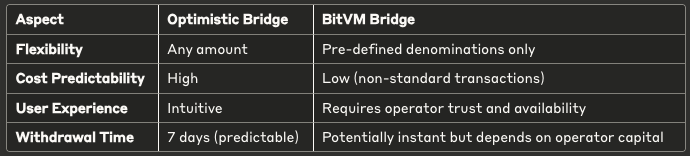
Based on the bridge comparison and technical constraints demonstrated above, several critical issues emerge that could prevent BitVM from achieving mainstream Bitcoin DeFi adoption. Let me examine these challenges across three key dimensions: economic viability, user experience limitations, and practical implementation concerns.
Economic Model Uncertainties
BitVM's economic viability faces several critical challenges:
1️⃣ Cost Factors
Transaction Costs: 3-4 Bitcoin transactions per bridge operation, currently non-standard with unpredictable fees
Operator Capital Requirements: Operators must front capital (e.g., 1 BTC for 7 days), creating significant opportunity costs
Operational Overhead: Each bridge instance (~0.1 BTC) requires ~3GB storage plus substantial computing resources
Binding Commitments: Operators must remain available and committed throughout the process
2️⃣ The Viability Question
The fundamental question remains: What economic model makes BitVM sustainable for operators and challengers? Typically, operational costs transfer to users, potentially making BitVM bridges prohibitively expensive despite technical feasibility.
While significant effort has focused on optimizing on-chain transactions and program size, the core model's requirements—pre-signed transactions and operator involvement—remain unchanged. Making operator capital fronting optional would severely degrade user experience and introduce uncertainty.
3️⃣ User Experience Challenges
BitVM's workaround approach creates several usability compromises:
Limited Flexibility
Fixed Denominations: Users can only bridge specific amounts (e.g., exactly 0.1 BTC)
No Customization: Pre-execution and pre-signed transactions eliminate flexibility
Scaling Limitations: Without advanced Bitcoin OP_codes, these constraints persist
Single Point of Failure Concerns
Operator Collusion Risk: If all operators go offline simultaneously, users face complex recovery procedures
Technical Complexity: Average users cannot easily execute peg-out procedures independently
Trust Dependencies: Despite "1-of-n majority" claims, pre-configured nature and operator involvement create potential failure points
Conclusion: The Reality Check
While BitVM represents an impressive technical achievement and addresses real needs in the Bitcoin ecosystem, significant barriers prevent it from enabling mainstream Bitcoin DeFi:
Technical Limitations:
Fixed denomination constraints
Economic model uncertainties
Complex user experience requirements
Practical Concerns:
High operational costs likely passed to users
Dependency on operator availability and honesty
Limited flexibility compared to Ethereum DeFi
The Verdict: BitVM may enable niche Bitcoin DeFi applications for sophisticated users willing to accept higher costs and complexity. However, the mainstream DeFi experience that Ethereum users enjoy remains elusive on Bitcoin, even with BitVM.
The technology shows promise, but fundamental limitations in Bitcoin's scripting capabilities and the resulting economic/UX trade-offs suggest that BitVM will likely serve specialized use cases rather than democratizing Bitcoin DeFi for everyday users.
Future iterations and alternative implementations may address some of these limitations, but the core constraints appear inherent to working within Bitcoin's existing framework.